Zaha Hadid: The Baghdad-born woman who reshaped skylines around the world
Summary: The first woman to ever win the prestigious Pritzker Architecture Prize - the world's highest honor in the field of architecture and often called the "Nobel Prize of architecture" - reshaped skylines from London to Guangzhou and New York to Baku with her striking curved designs. A decade after her untimely death in 2016, her greatest legacy across the region of her birth continues to unfold, from Riyadh's metro and Qatar's Al Janoub Stadium to the Royal Theatre of Rabat and the brand new Central Bank of Iraq towering over the Tigris.
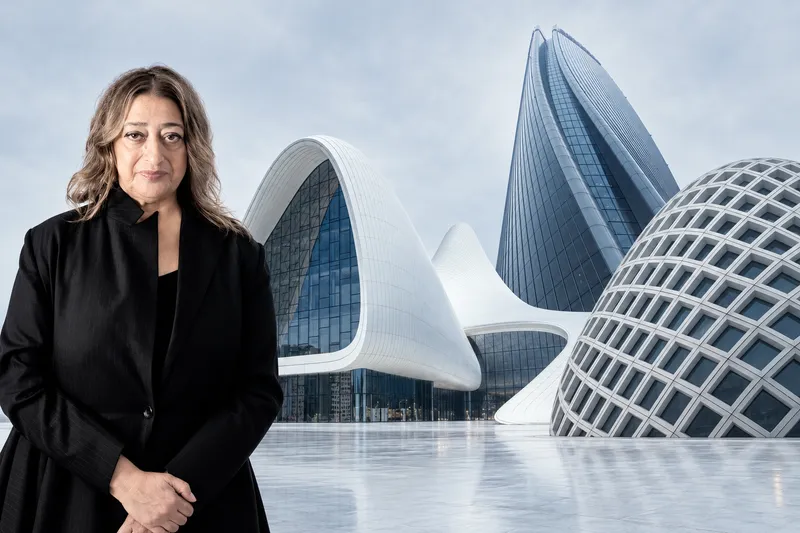
When Zaha Hadid passed away unexpectedly in Miami in 2016, she was already an icon in the world of architecture. She was the first woman to ever receive the Pritzker Architecture Prize in 2004. In 2008, Forbes named her among “The World’s 100 Most Powerful Women” and Time followed suit in 2010 by including her among the "Time 100." She was awarded the prestigious Stirling Prize two years in a row in 2010 and 2011. And in 2012, Queen Elizabeth II honored her for the second time by making her a Dame Commander of the Order of the British Empire.
Yet despite this enormous success during her lifetime, the full extent of her talent and genius continues to unfold to this day, with some of her greatest architectural design work only reaching completion during the past decade following her untimely death.
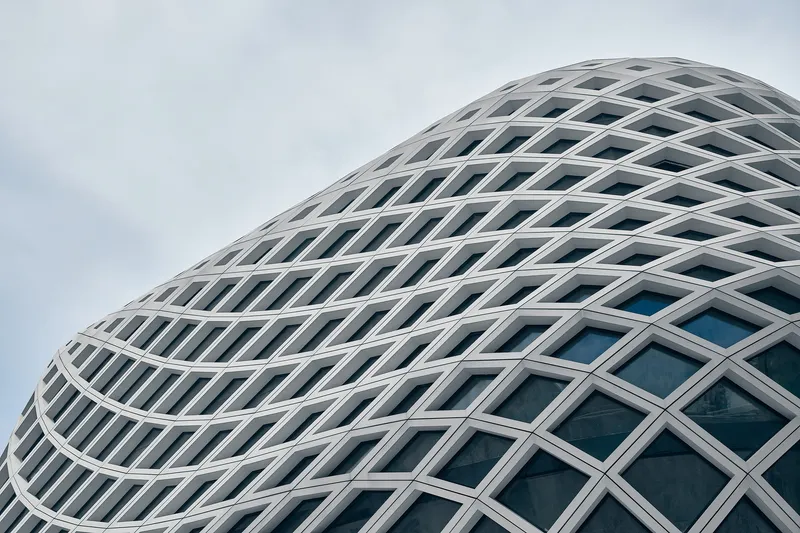
Zaha Hadid was born in Baghdad on October 31, 1950 at a time when the Iraqi capital was widely regarded as contemporary, cosmopolitan, and progressive. She attended a convent school in Baghdad before leaving for boarding schools in Switzerland and England, but she returned to the region in 1968 to study mathematics at the American University of Beirut.
In 1972, she moved to London to study architecture at the Architectural Association. Her early work as a student was influenced heavily by the Russian avant-garde style, which earned her the school's notable Diploma Prize in 1977. Following her graduation, she was invited by two of her professors to join their architectural firm in the Netherlands. By 1980, however, she returned to London to launch her own architectural firm - Zaha Hadid Architects.
Recognition of Hadid’s talent came long before any of her designs made their way into brick and mortar - or in her case, glass and steel. She won a 1983 competition for designing a leisure club in Hong Kong known as The Peak, and in 1994 she won the competition for Cardiff Bay Opera House in Wales, although neither design was ultimately used.
While she was gaining a reputation throughout the first decade of her career for the unique new architectural style of her designs, she also pursued a parallel career in teaching. Her first professorship was at the Architectural Association where she had honed her own talent in the early 1970s, but she later went on to lecture at Cambridge, Harvard, Columbia, Yale, the University of Illinois at Chicago, the University of Fine Arts Hamburg, and the University of Applied Arts in Vienna.
Hadid's first major building project that made it through to construction was the Vitra Fire Station in Weil am Rhein, Germany, which was completed in 1993. Though small in scale, her striking concrete and glass design for the fire house hit the pages of architecture magazines before an ounce of concrete had even been poured. By the end of the decade, she was already becoming known as a pioneer in the field, which helped her land several major architectural projects, out-competing more established colleagues in the field to design the replacement for the 1964 and 1976 Winter Olympic ski jump in Bergisel, Austria; the Rosenthal Center for Contemporary Art in Cincinnati, Ohio; the Phaeno Science Center in Wolfsburg, Germany; the BMW Administration Building in Leipzig, Germany; and an extension of the Ordrupgaard Museum in Copenhagen, Denmark.
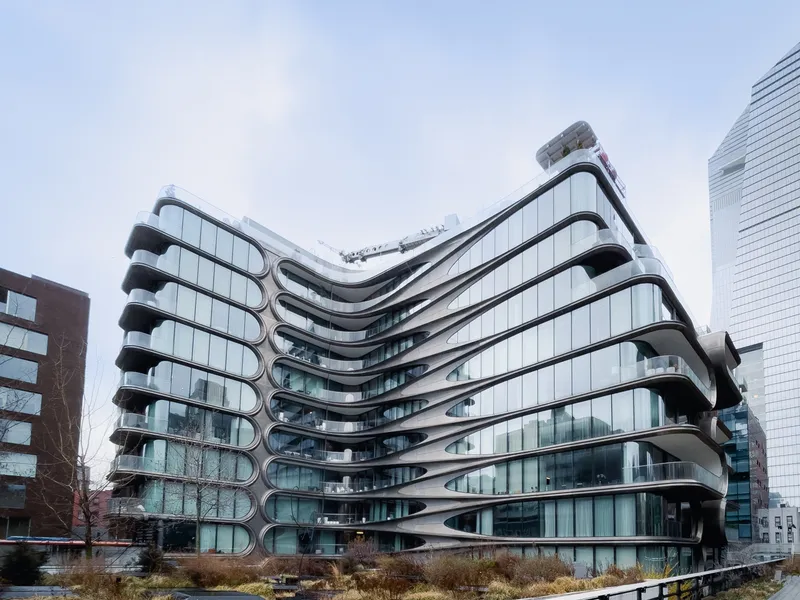
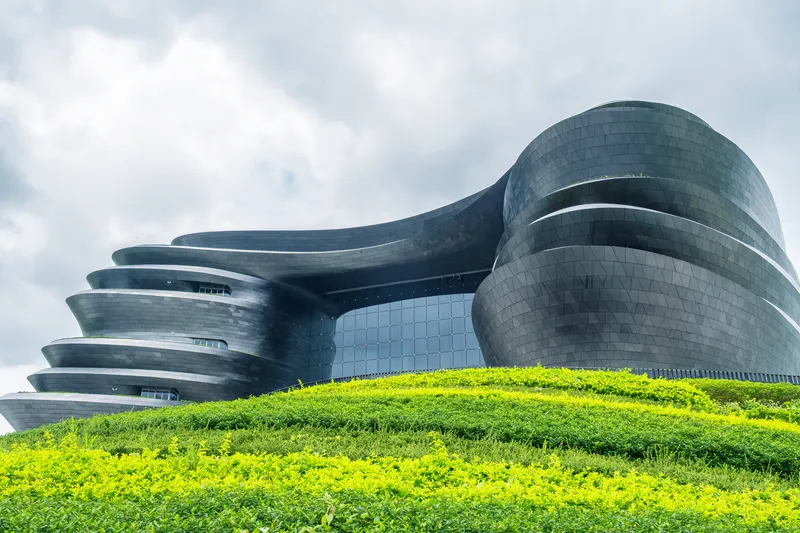
If the 1990s gained her renown within the professional architectural community, the early 2000s saw Hadid’s name rise to prominence within much wider international circles. Not only did the projects she designed grow in size, but she began expanding her scope from just buildings into the engineering-dominated world of bridges as well. Alongside her work during this period on the National Museum of Arts of the 21st Century in Rome (aka MAXXI) and the Guangzhou Opera House in China, she also took on the new Zaragoza Bridge Pavilion in Spain and the Sheikh Zayed Bridge project in Abu Dhabi, the opening of which in 2010 was attended not only by the President of the United Arab Emirates and Ruler of Abu Dhabi, but also by Queen Elizabeth II.
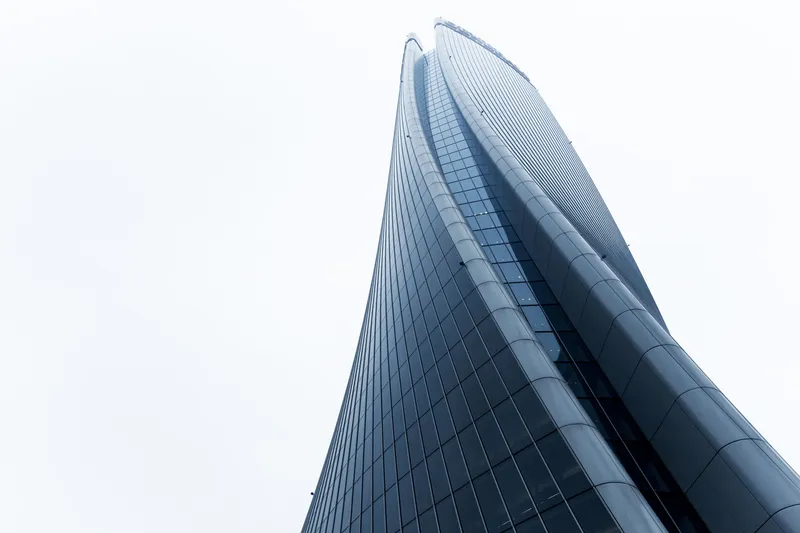
With the United Kingdom hosting the 2012 Summer Olympics, the new London Aquatics Centre that Hadid designed was hailed by The Guardian as “the Olympics’ most majestic space,” with its wave-like roof that covered three swimming pools and 17,500 spectator seats. The same year brought the opening of additional projects she designed as far afield as the United States, where the striking angles of Michigan State University’s new Broad Art Museum actually change color depending on the angle of the sun in the sky and even the weather, and China, where her Galaxy SOHO building’s four curved towers exhibit what she referred to as "continual curvilinearity.”
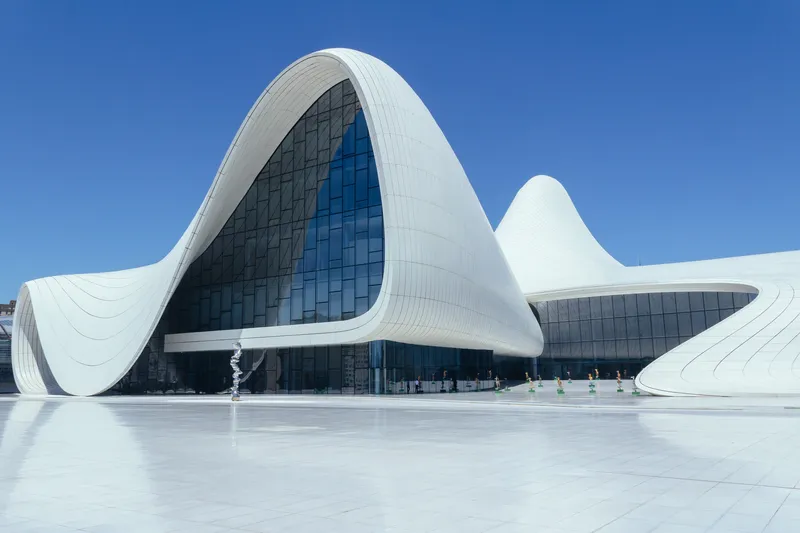
Of all her buildings, the one many consider her masterpiece towers over Azerbaijan’s flashy, oil-rich capital. The Heydar Aliyev Center in Baku, a cultural center that opened in 2012, rises from its surrounding plaza as a single flowing white surface with no hard edges. Architectural Review deemed the building "a white vision,” "a unique object that confounds and contradicts the reasonable,” and "a wave form sweeping up, almost lunging, into the sky.” In 2014, the Aliyev Center won the Design of the Year award from the London Design Museum, the UK’s top architectural prize.
In the following few years just before her passing, aged only 65, Hadid really began to hit her stride. Her growing portfolio, by then resembling works of public art rather than just functional buildings, was reaching fruition in even greater numbers across Asia - the Wangjing SOHO office complex in Beijing, Sky SOHO in Shanghai, Jockey Club Innovation Tower in Hong Kong, and Dongdaemun Design Plaza in Seoul - and throughout Europe, including the library of the Vienna University of Economics and Business, the Serpentine North in London, and the Port Authority Headquarters in Antwerp.
However, her greatest impact on the region of her birth would not come until after she was gone. These architectural masterpieces would be born of a combination of her own designs that she never lived to see completed and the work of the colleagues she mentored and inspired at Zaha Hadid Architects who continued the firm’s work on her behalf.
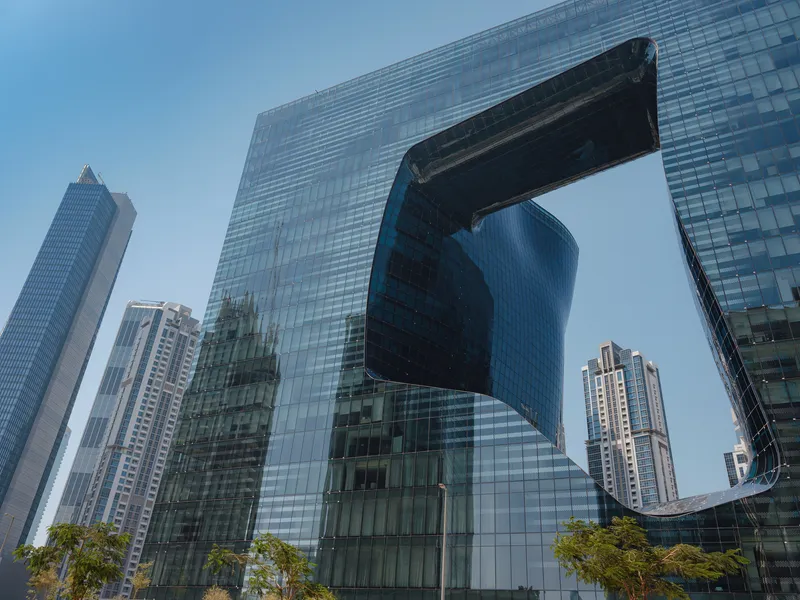
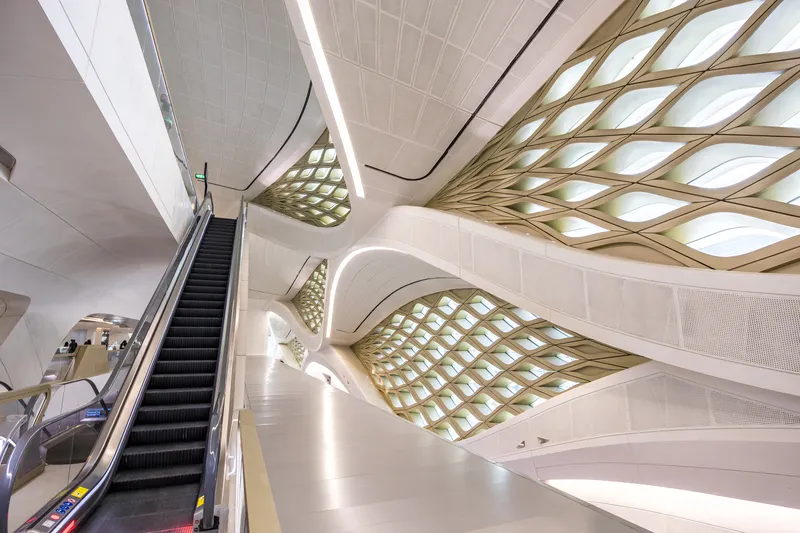
These posthumous projects included the King Abdullah Petroleum Studies and Research Center in Riyadh, opened in 2017; the Opus in Dubai, a glass cube carved through by a free-form void that opened in 2020; the Al Janoub Stadium in Qatar, completed in time to help host the FIFA World Cup; the net-zero emissions BEEAH Group Headquarters in Sharjah, inaugurated in 2022; the King Abdullah Financial District metro station, completed in 2024 and hailed as one of the centerpieces of the new Riyadh metro system; and the Royal Theatre of Rabat, which King Mohammed VI personally asked Hadid to design back in 2010 and which finally opened to the public in 2026.
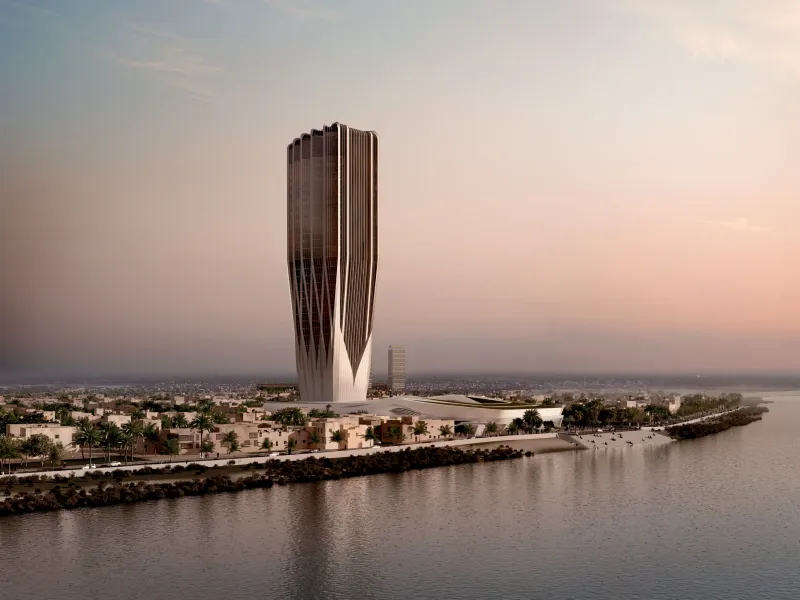
But the project with perhaps the deepest personal meaning for Hadid now dominates the skyline of Baghdad along the banks of the Tigris River. In 2010, the Central Bank of Iraq commissioned Hadid to design its new headquarters building, her first project in the city where she was born. Commenting at the time that she was “deeply touched” by the commission, she set out with her long-time firm partner Patrik Schumacher to design a tower that would become the tallest building in Baghdad and a landmark to her legacy in the country of her birth. Construction was finally completed in 2026, and the building is expected to be inaugurated some time next year.
In early 2016, Hadid was basing herself out of one of her residences in Miami Beach, Florida, where she had been overseeing the construction of a 62-story residential building known as One Thousand Museum, named so because of its location adjacent to Miami’s Museum Park. In February of that year, the Royal Institute of British Architects awarded her their Royal Gold Medal, making her the first woman to receive the prestigious award as a sole recipient in the prize’s then 168-year history.
When reflecting on her career in a radio interview with the BBC that same month, Hadid remarked, “I don’t really feel I’m part of the establishment. I’m kind of on the edge and I’m dangling there. I quite like it… I’m not against the establishment per se. I just do what I do and that’s it.”
The following month, Hadid contracted bronchitis, which progressed to the point that she had to be admitted to the nearby Mount Sinai Medical Center. Within the span of less than a week, while still hospitalized and undergoing treatment, Hadid suffered a heart attack and died on March 31, 2016.
Zaha Hadid never married and had no children. The architectural firm that she founded in 1980 and which bore her name - and which perhaps symbolically became her life partner and her child - announced her death to the world: “It is with great sadness that Zaha Hadid Architects have confirmed that Dame Zaha Hadid DBE died suddenly in Miami in the early hours of this morning… Zaha Hadid was widely regarded to be the greatest female architect in the world today.”
Almost immediately, the tributes began pouring in from across the globe. The UK’s minister of culture tweeted "Stunned to hear that the brilliant architect Zaha Hadid has died - she made a huge contribution to contemporary architecture.” Then-mayor of London, Boris Johnson, followed suit with "So sad to hear of the death of Zaha Hadid. She was an inspiration, and her legacy lives on in wonderful buildings in Stratford and around the world.”
Her rejection of traditional straight lines and right angles in architectural design earned her the affectionate nickname “Queen of the Curve” during her lifetime. But the career she built and the legacy she left behind deserve a more befitting title. She didn’t just produce whimsical designs that dazzled and delighted onlookers. She engineered timeless works of public art on a massive scale in which people all around the world continue to live their lives, build businesses, and run governments. She did so not just with physical materials, but also using the curves of bended rules and the glass of shattered ceilings in a world in which a woman who was born in Baghdad in the 1950s was never expected to even enter a career field so firmly dominated by men, much less out-compete her male peers and then repeatedly be honored by them with the profession’s most prestigious prizes and awards.
Zaha Hadid was not just an architect. She was a visionary artist whose masterpieces are too large to hang in museums beside the likes of da Vinci, van Gogh, and Picasso. Entire neighborhoods were her canvases and entire cities are now her galleries. And the firm she birthed and nurtured, her metaphorical child which now calls itself ZHA, will thankfully continue advancing her vision and her legacy for the benefit of humanity over generations to come.