Why the Rosetta Stone is so important to Egypt and Egyptian history
Summary: Of the hundreds of thousands of artifacts that have been unearthed so far across Egypt, none is as important to Egyptian history and Egyptian cultural identity as the Rosetta Stone. This one artifact unlocked virtually all of Egyptian history for scholars and the world by enabling the translation of thousands of years of the country's history that had been hidden in plain sight for over 1400 years, seemingly everywhere yet completely unreadable until a young French linguist experienced his "aha moment" and brought an ancient civilization's story back to life.
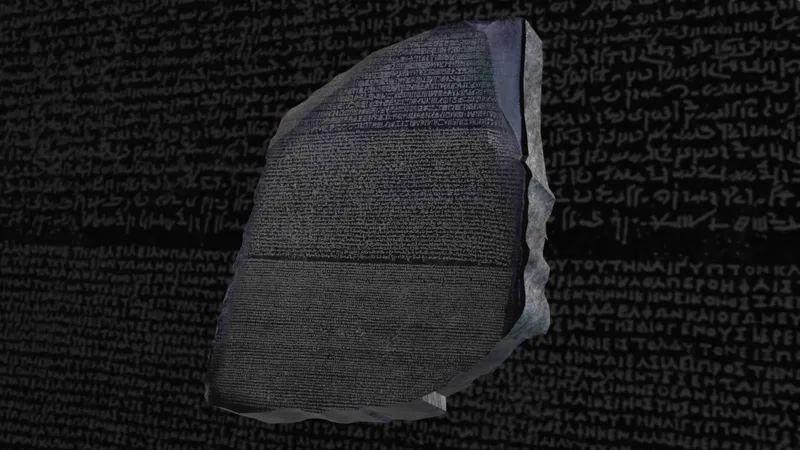
For most of the past two centuries, the story of the Rosetta Stone has been told as a tale of European genius: French soldiers stumble upon a broken slab in the Nile Delta, a brilliant young Frenchman cracks the code, and the world's most famous key to a lost language ends up on permanent display in London. It is a tidy narrative, and the British Museum, where the stone has been on display since 1802 and remains one of its most visited objects, has had little reason to complicate it. But the fuller story is older, stranger, and considerably more Egyptian than the version most visitors absorb while jostling for a photo in front of its display case.
The stone itself was never meant to be a dictionary. It is a fragment of a larger granodiorite stela, weighing roughly 760 kilograms (1,680 pounds), carrying a decree issued in 196 BC by a council of Egyptian priests meeting at Memphis to honor the teenage king Ptolemy V on the anniversary of his coronation. The Ptolemies were a Greek-speaking dynasty of pharaohs who descended from one of Alexander the Great's generals, Ptolemy I, and the decree is as much a piece of political theater as a religious text - a foreign-born royal house securing the loyalty of Egypt's powerful priesthood, and the priests extracting tax privileges and honors in return.
That is why it was written three times. The Greek text spoke to the court and the administration. The demotic text, a cursive script descended from hieroglyphs that Egyptians used for everyday business and legal documents, spoke to the literate public. And the hieroglyphic text, by then reserved largely for temples and monuments, spoke to the gods.
Copies were set up in temples across the country, and the one that survived happened to be reused as building material centuries later in the walls of an old fort near the Delta town of Rashid, known to French as Rosetta. French soldiers renovating that fort during Napoleon's occupation of Egypt happened to stumble across it in July of 1799, and the officer in charge luckily recognized its significance almost immediately.
The stone was transported to the newly founded Institut d'Égypte in Cairo where copies were made and circulated to scholars across Europe. In 1801, after British forces defeated the French army in Egypt, the stone was taken by the British under the terms of the French surrender at Alexandria, shipped to England, and presented to the British Museum.
By then, no one had been able to read hieroglyphs for well over a thousand years. The last known hieroglyphic inscription was carved at the temple of Isis at Philae in Aswan in 394 AD, and in the centuries that followed, European thinkers came to treat the script as a system of mystical symbols rather than a language. A fifth-century Greek treatise called the Hieroglyphica cemented that idea, and as late as the 17th century the Jesuit scholar Athanasius Kircher was producing elaborate - and entirely wrong - "translations."
Some of the earliest correct instincts about hieroglyphs actually came from the Arab world. The Egyptologist Okasha El-Daly, of University College London, has argued that medieval Arabic scholars understood that ancient Egyptian was related to Coptic and that some hieroglyphs carried sound values, and he points in particular to a treatise attributed to the Iraqi-born writer Ibn Wahshiyya that matched hieroglyphs to Arabic letters. The extent of what those scholars actually got right is still debated, but the work was translated into English and published in London in 1806, a decade and a half before the decipherment that made Champollion famous.
The race to read the Rosetta Stone itself became a rivalry between two very different men. Thomas Young, an English physician and polymath, began working on the texts in 1814 and made significant progress. He recognized that the oval rings, which we now call cartouches, enclosed royal names. Young was able to identify the name Ptolemy in one of them and subsequently worked out the sound values of several signs, publishing his findings in an 1819 article for the Encyclopaedia Britannica. But Young remained convinced that hieroglyphs were mostly symbolic and used sounds only to spell foreign names - a critical mistaken assumption that kept him on the wrong path in his efforts to decipher the language.
Jean-François Champollion, a French linguist who had studied Coptic since his teens, was ultimately the one who made the decisive breakthrough. Coptic, the final evolved version of the ancient Egyptian language, was written in an alphabet adapted from Greek and still used in the liturgy of Egypt's Coptic Church. This gave Champollion something that Young lacked - a living echo of the language the hieroglyphs recorded. Comparing the Ptolemy cartouche with the name of Cleopatra on an obelisk from Philae, Champollion confirmed a set of sound values, and then, applying them to cartouches from earlier pharaonic monuments, he was able to read the names of Ramesses and Thutmose.
In September of 1822, Champollion announced his results in his famous letter to the French academician Bon-Joseph Dacier, and two years later he laid out the full system - hieroglyphic writing combines signs that stand for sounds with signs that stand for ideas, often in the same word. That insight remains the foundation of Egyptology. It turned the walls of every temple and tomb in Egypt, as well as thousands of papyrus scrolls collecting dust in museum warehouses and storage rooms all over the world, from mere decoration into historical documentation. In effect, the decipherment did for ancient Egypt what the discovery of a lost archive would do for any nation - it gave a civilization its own voice back after 1,400 years of silence.
Champollion finally visited Egypt in 1828 and died in 1832, aged 41. The bitter dispute over credit between his supporters and Young's, layered over decades of Anglo-French rivalry, lasted long after both men were gone. And that brings the story back to London, and to the question that has followed the stone through the bicentenary of the decipherment and into the opening of the Grand Egyptian Museum: where does the Rosetta Stone belong?
The British Museum's position rests on the British navy's 1801 surrender agreement with the French, which it claims is legitimized by the signature of an representative of the Ottoman sultan in Istanbul, and on the British Museum Act of 1963, which tightly restricts its ability to permanently give up objects in its collection. The museum also maintains that Egypt's government has never submitted a formal request for the stone's return. However, supporters of repatriation counter that Egyptians had no say in a deal struck between two foreign armies fighting over their country.
For perspective, imagine the original Declaration of Independence or the British crown jewels on permanent display in Paris or Moscow because a foreign army had carried it off during a war, and its current custodians insisting that a treaty signed by the occupiers settled the matter.
The practical objections to returning it have also weakened considerably. For decades, opponents argued that Egypt lacked a museum capable of housing and protecting its most important antiquities. That argument became much harder to make in November 2025, when the $1 billion Grand Egyptian Museum opened adjacent to the Pyramids of Giza with the complete treasure collection of the pharaoh Tutankhamun on display. Nor was the British Museum's case helped by its own disclosure in 2023 that some 2,000 objects had gone missing from its storerooms, a loss it attributed to a member of its own staff.
International pressure has also been mounting. ReturnTheStone.org, a global grassroots campaign launched in 2001, has carried the cause directly into the British Museum's galleries, staging respectful silent protests inside the museum itself directly beside the Rosetta Stone in 2022 and again in 2023.
None of this is to say the stone will be back on the banks of the Nile anytime soon. But if we have learned anything from the past two centuries of its history, it is that the Rosetta Stone has always been a document about who holds power and who gets to speak for Egypt. With a world-class museum now standing proud in Giza and a growing global audience asking why Egypt's most famous identity-defining artifact remains in London, we should expect that question to become steadily harder for the British Museum to avoid.