Ancient war horse found buried with full honors in Egypt’s Nile Delta
Summary: Archaeologists at Egypt’s Tell Al-Abqain fortress uncovered a carefully arranged burial of a young war horse, possibly honoring the animal, alongside residential buildings, royal inscriptions and other artifacts. Separately, a China-Egypt mission at Karnak’s Temple of Montu revealed four complete Osirian chapels and confirmed two adjacent sacred lakes, with both excavations continuing.

Egyptian archaeologists have uncovered the complete, deliberately arranged burial of a young war horse at Tell Al-Abqain, a New Kingdom fortress in Beheira governorate on the western edge of the Nile Delta, the Ministry of Tourism and Antiquities announced on September 16. The fortress was one of several built along the Delta’s western frontier to protect Egypt from attacks by Libyan tribes.
Mohamed Abdel-Badie, head of the Egyptian Antiquities Sector, said preliminary study shows the horse was a medium-sized breed valued for speed and agility, the type used in the New Kingdom for training, military work, or pulling war chariots. The position of the body, the orientation of the head, and the orderly burial indicate the animal was interred with care, and the ministry suggests it may have received an honorific burial. A few meters away, the team found alabaster and limestone pieces believed to have decorated a chariot harness.
The excavation also exposed a planned mudbrick residential complex. Hisham El-Leithy, secretary-general of the Supreme Council of Antiquities, said a main street about 4 meters (13 feet) wide runs east to west and crosses a second street running north to south, with rooms holding grain silos, cylindrical pottery ovens and large jars of charred wheat.
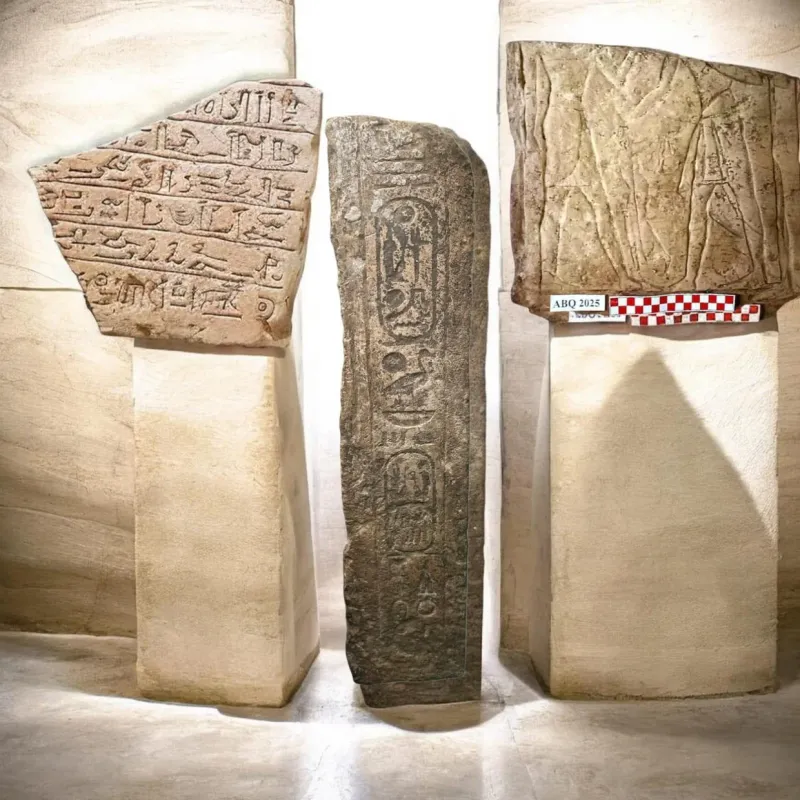
Khaled Abdel Ghany Farhat, director general of the Beheira Antiquities Area and the excavation’s supervisor, said the mission also recovered part of a limestone stela carrying a hieratic text of King Merneptah, the first such find in the history of excavations in the area. Other finds include a stela bearing the names of Ramesses II, another depicting a bound Libyan prisoner of the Meshwesh tribes, scarabs naming Ramesses II and Seti I, protective amulets and a flask associated with pilgrimage to Abydos.
A week later, China’s National Cultural Heritage Administration reported new results from the China-Egypt joint mission at the Temple of Montu, in the northern part of the Karnak complex in Luxor. The team has uncovered the complete structures of the second through fifth of the temple’s small Osirian chapels and confirmed that the precinct holds two sacred lakes side by side, the second of which the mission first announced in January. Working since November 2018, the joint team has completed eight seasons and uncovered more than 2,000 square meters (21,500 square feet).
Both missions are continuing their work. The announcements come in the Grand Egyptian Museum’s first year of full operation, with the ministry forecasting as many as 20 million international arrivals for 2026, which would surpass last year’s record of about 19 million.